
Different than other PPV fans

Ventry® Positive Pressure Ventilation (PPV) Fans have very specific advantages for firefighters over all other PPV fans. Conventional PPV blowers are those which operate within a foot of the ground and use mass-produced propellers. Basically, all fans other than Ventry Fans are standard conventional fans.
Compared to or in contrast to other fans, Ventry Fans...
- Are versatile in aiming and placement.
- Are stable when set up on stairs, hills, and over obstacles.
- Have preferred overall geometry for ventilation (raised air).
- Have similar and often higher air output.
- Weigh less than competitor models of similar output.
- Are quieter.
- Produce a more consistent, uniform, tight air stream for better entrainment.
- Are more stable, less likely to walk, and are difficult to knock over.
- Are less likely to shut down at critical times.
- Have no batteries to charge or replace.
- Are better ergonomically because the controls are raised within reach.
- Are safer, due to our unique, proprietary Safety Propellers.
- Come with outstanding customer service.
- Improvements are applied to all models, not just one new model at a time, so all customers benefit from our innovation.
Read an excerpt here from a fire fighter who summed up some benefits in a concise letter of recommendation.
Placement, Aiming, and Overall Geometry for PPV
Because of the propellers and legs, Ventry Fans can be set far back from the door.
For other fans to blow over stairs and other obstacles, they may need to be propped up with other objects or tipped far enough, which can activate the engine oil alert feature and shut them down in the middle of ventilation.
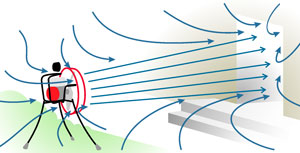
With Ventry Fans, legs elevate the air stream over obstacles near the door (like stairs), reducing any additional angle they’d need to then be tipped.
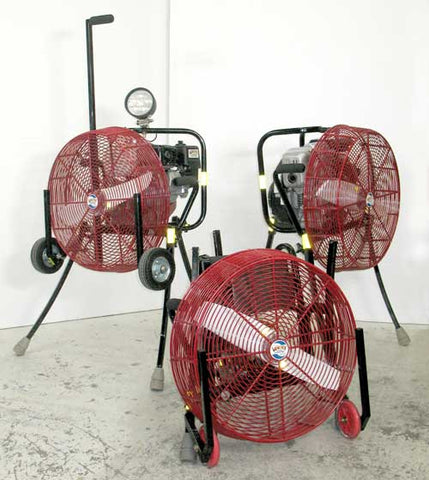
The higher/raised position of Ventry Fans aims the air most squarely at the entrance so a door seal or entrainment through the entry is much easier to establish. Whether you subscribe to the conventional Cone of Air / Door Seal or Straight Stream Airflow concepts, if the fan is properly positioned, entrainment is happening and it increases air flow. Being closer to parallel with the ground, Ventry Fans’ air stream momentum is preserved through less shadowing of the ground, driving more fresh air deep into the structure, bouncing less off the ceiling, and reducing disturbance of the thermal balance (stirring of the smoke).
We do a lot of engineering and design work on our propellers to create a uniform, tight air stream. You may see the concept mentioned elsewhere as brand new technology (air straighteners, turbo ventilators, power stream, pow-air technology, Laminar Air Flow or LAF, StreamShaper...), but Ventry Fans have always had a very narrow air stream due to the propellers’ shapes.
For firefighters, it means they can put their Ventry Fan back in the rose garden and leave the sidewalk clear for advancing hose line. In fact, with Ventry Fans, it is much better to put the fan too far away than too close! They should be placed at least 8 feet or further from the entry point and it is better to have the fan too far away than too close. Learn more: Open the “2 Secrets” flyer (PDF).
Raising the fan high up off the ground greatly reduces the risk of the fan sucking in debris and either plugging or projecting it into the scene (as with leaves, rocks, dirt, and sand).
TRUE STORY. Instead of a Ventry Fan, fire fighters were using a conventional fan (without legs) during ventilation training and noticed from the back side of the structure that not much air was coming out. When they checked on their fan, they found that it had sucked in leaves from all around in a 15-foot radius and was plugged, because it was on the ground. That won’t be a problem with their new Ventry Fan! ~ As told by Fire Fighter Purk in Oak Harbor, Ohio
PPV Fan Airstream Quality
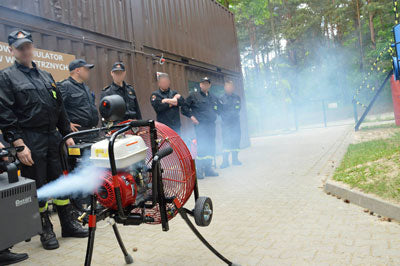
“Using smoke machines and applying the smoke from behind the fan can help visualize the shape of the stream and give a better understanding of the positive pressure streams.” (Kokot-Góra)
The quality of the air stream on a PPV Fan is very important. If you hold a handkerchief in front of any multiple-blade fan and move it around within the air stream, you will find that the strength of flow varies greatly within the circular plane. The strongest points are often at the outer edges of the circle and hit the outside of the door when properly sealed, thereby leaving the weakest points in the center to enter the structure. With Ventry Fans, the air cone is very focused and uniform across the entire stream. You won’t lose the strongest part of the air stream on the edges of the door (or shadowed on the ground); instead, the air is directed into the structure.
Face-to-Face Blow-Off between 2 PPV Fans
This video shows what our customers have been experiencing for decades. It is posted with permission from the Richfield Volunteer Fire Company. They recorded their blow-off between two fans, both with 24-inch long propellers. The Ventry GX200-powered fan (rated 5.5 hp) is on the left and the competitor’s GX240-powered fan (rated 8 hp) is on the right.
Watch the yellow ribbon in the middle.
We encourage you to test and try and compare fans before you buy. Call us to arrange this: 888-257-8967.